The Frontline Education Breach: A Wake-Up Call for Schools That Rely on EdTech Vendors
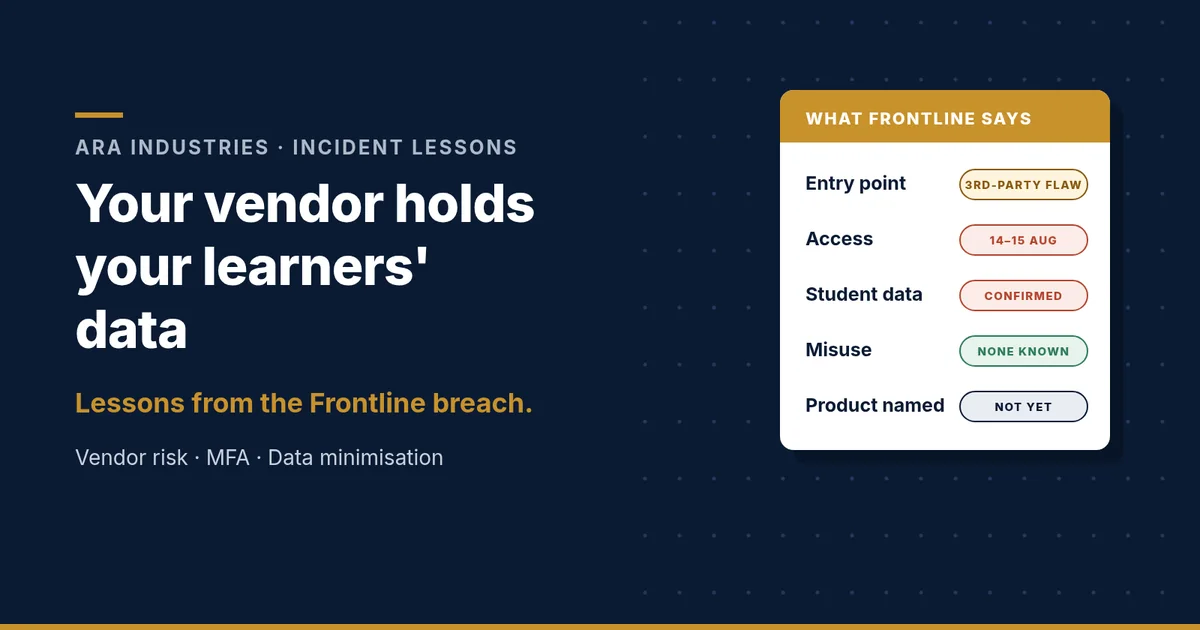
Facts checked 3 November 2026 (PHT). Frontline has not named the third-party product, and no group has been publicly confirmed as responsible. We will update this post if that changes.
What happened (confirmed)
- Frontline Education, a US provider of school administration software, says its security team found on 14 August 2026 "a vulnerability in a third-party software product we use that allowed unauthorized access to a portion of the environment". The last day of unauthorized activity was 15 August. (Frontline notice)
- The affected systems were Frontline Central (an employee management platform) and School Health Management (school nurse documentation and Medicaid billing). (Frontline notice; Cybernews)
- Data elements, varying by person: Social Security numbers, dates of birth, driver's license and passport numbers, other government IDs, Medicaid IDs and student IDs. Districts also reported names, email addresses and home addresses. (Frontline notice; BleepingComputer; Greenville County Schools)
- Timeline: detection 14 August; district notifications began around 1 October, first about employee data; student data confirmed later; individual letters from about 26 October. (BleepingComputer; Frontline notice)
- Examples reported by districts: almost 17,000 current and former students at Greenwood School District in South Carolina, and around 45,000 potentially affected people at Killeen ISD. Greenville County Schools said only the health system was involved and its internal systems were not breached. (Cybernews; Greenville County Schools)
What is still unknown
- Which third-party product was exploited. Frontline has not said.
- Who did it. No threat actor has been publicly confirmed, and we found no verified claim.
- Total numbers. How many students, staff and districts were affected overall has not been published.
- Whether the data has been misused. Frontline says it is not aware of any misuse so far.
One more point deserves attention: the break-in ended on 15 August, but districts began hearing about it around 1 October, and student data was confirmed later still. Frontline says its file analysis was "thorough and time-intensive". For a school, that gap is time you cannot get back.
Why this matters for Philippine schools
Philippine schools, colleges and DepEd offices increasingly run on outside platforms: learning management systems, enrollment and student information systems, payment portals, clinic records and HR tools. Each one holds learner data, and in basic education most learners are minors.
- The school stays accountable. Under the Data Privacy Act (RA 10173), the school is usually the personal information controller. See our guide to school data privacy in the Philippines. A vendor holding the data is a processor, but the duty to protect learners, and to notify, stays with the school.
- The 72-hour clock. Under NPC Circular 16-03, when a breach involves sensitive personal information (or data that could enable identity fraud) and is likely to cause real risk of serious harm, the controller must notify the Commission and affected people within 72 hours of knowing, or reasonably believing, that it happened. If a vendor takes weeks to tell you, that clock is hard to meet, so your contract should set a short notice period.
- Sensitive data piles up. Health and clinic records, education records and government-issued ID numbers are sensitive personal information under the Act. If a system does not need them, it should not store them. Clinics face the same question; see our clinic data privacy guide.
- Small teams. Many schools have one IT person, or none. That makes vendor choice and contract terms, not tools, the main control.
For more on PH breach notification, browse our data privacy and compliance insights.
How we could have protected ourselves
A school could not have patched Frontline's third-party software. It can control what it hands over, what it demands from vendors, and how fast it responds.
1. Ask vendors hard questions before signing (and at renewal)
- Where is our data hosted, and who at your company can access it?
- Do you require MFA on all admin, support and developer accounts?
- How do you track and patch third-party software you rely on, and how quickly?
- How soon will you notify us of a suspected incident? (Ask for 24 hours in writing.)
- Can you show an independent audit or certification, and a recent test report?
- Will you delete our data when we leave, and prove it?
2. MFA and least privilege, on both sides
Turn on MFA for every school admin account on vendor platforms. Give vendor support staff access only when needed, for a limited time, and remove it after.
3. Logging and alerting
Ask whether the platform keeps audit logs you can see: logins, exports and bulk downloads. Someone should review alerts for unusual exports.
4. Collect less, keep it shorter
Do not use government ID numbers as student IDs. Do not upload data a system does not need. Set retention periods and purge records of learners who left years ago. Greenville County Schools noted it stopped collecting Social Security numbers from students for exactly this reason.
5. Have an incident and parent communication plan ready
Name who decides, who calls the NPC, and who writes to parents. Draft a plain-language parent notice template now, in English and Filipino, so you are not writing it under pressure.
Quick checklist for school heads and IT
- We have a list of every outside system that holds learner or staff data.
- Each has a signed data sharing or outsourcing agreement with breach notice within 24 hours.
- MFA is on for all admin accounts, ours and the vendor's.
- Vendor support access is time-limited and logged.
- We do not store government ID numbers we do not need.
- Old learner records are purged on a set schedule.
- Our DPO knows the NPC 72-hour process and has a parent notice template.
- We have tested the plan at least once this school year.
Where ARA Industries can help
ARA Industries helps schools and education offices review vendor contracts and data flows, tighten account security, and prepare a breach response plan before one is needed. Independent penetration tests are available via partner. If you want a second look at your vendor list, let's talk.
Frequently asked questions
Were Philippine schools affected by the Frontline Education breach?
Nothing published so far points to that. The notices we read concern US school districts. The lesson applies to any school that stores learner data with an outside software provider.
If our LMS or school system provider is breached, who is responsible under the Data Privacy Act?
Under RA 10173 the school is usually the personal information controller and stays accountable for learner data, even when a vendor (the processor) holds it. Your data sharing or outsourcing agreement should require the vendor to tell you quickly so you can meet the NPC's 72-hour notification rule.
What is the single most useful thing a school can do this term?
List every outside system that holds learner or staff data, then ask each vendor the questions in the checklist below. Collect only the data you need, especially government ID numbers.
Does a breach at a vendor mean the school was hacked?
Not necessarily. In this case Greenville County Schools, for example, said its own internal systems were not breached. The data was taken from the vendor's environment, but the impact still fell on the schools' learners, staff and families.