The Binance Incident: How One Admin Laptop Can Open the Door
Facts checked 30 October 2026, 2:50 PM (PHT). Binance's investigation is ongoing and its technical post-mortem has not been published yet. We will update this post when it is.
What happened (verified)
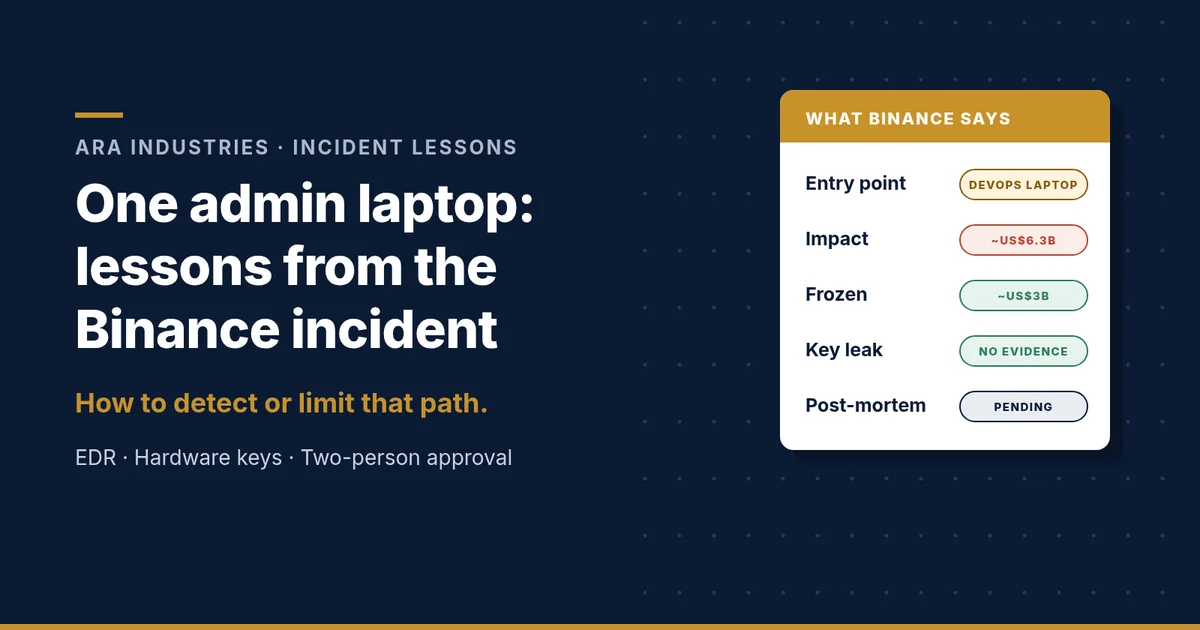
- On 29 October 2026, Binance said its initial investigation suggests the incident "may involve a compromised DevOps engineer's laptop", which allowed an attacker to gain access to a service container and submit unauthorised withdrawal transactions. (Binance, 29 Oct 2026)
- Binance said it found "no evidence of any wallet private key leak" and will share a detailed technical post-mortem once the investigation is complete. (Binance)
- Binance estimated the total impact at around US$6.3 billion, with about US$3 billion frozen on-chain so far. (Binance) CoinDesk reported that the frozen amount includes US$2.3 billion in USDT and USDC stablecoins, and described the incident as the largest crypto theft on record. (CoinDesk, 29–30 Oct 2026)
- Binance said it will cover all losses from its SAFU fund and company funds, temporarily suspended deposits and withdrawals, revoked the affected address authorisation and engaged law enforcement and blockchain intelligence partners. (Binance)
- On-chain tracking reported by Crypto Briefing shows the attacker still held about US$3 billion in assets across several blockchains on 30 October. (Crypto Briefing, 30 Oct 2026)
- The attack has been attributed by blockchain analysts (TRM Labs, ZachXBT via CoinDesk) to North Korea-linked groups. Binance has not confirmed this attribution. (CoinDesk)
What is not known yet: how the laptop was compromised in the first place, and exactly how access moved from the laptop to the withdrawal system.
How a compromised admin laptop usually turns into a breach
The details of this case are not public. The patterns below are common, well-documented ways engineering and admin devices get compromised. They are not a description of what happened at Binance.
- Credential and session theft. Infostealer malware, often delivered through fake software or a malicious download, collects saved passwords, browser cookies and cloud session tokens. A stolen session can sidestep a password and some forms of MFA.
- Poisoned developer tooling. A malicious package, extension or build script runs on the engineer's machine with their privileges.
- Social engineering. Fake job offers, "coding tests" or recruiter messages that ask the target to run a file are a long-running tactic against engineers in finance and crypto.
- From laptop to production. Once an attacker holds a DevOps engineer's access (SSH keys, cloud console sessions, CI/CD or container access), they can reach internal services that trust that identity.
The common thread: production trusts the laptop, so whoever controls the laptop inherits that trust.
How it could have been detected or limited
No single tool guarantees prevention. The goal is layers that make each step harder and raise the alarm faster.
On the endpoint: WithSecure Elements
- Endpoint protection can block known malware and risky downloads before they run.
- Elements EDR and XDR watch behaviour, not just files. An unusual process reading browser credential stores, a script dumping tokens or an unexpected outbound connection could be flagged, and the device isolated from the network.
- Exposure Management can find unpatched software and risky settings on admin machines before attackers do.
Watching around the clock: managed detection and response
An alert at 3 AM only helps if someone acts on it. For teams of roughly 20 to 500 people without a full-time security team, ARA Industries, a registered WithSecure partner, offers managed detection and response: we monitor WithSecure alerts, investigate and help contain threats on your behalf.
Controls that don't depend on any product
- Dedicated admin devices: privileged work happens on a locked-down device, not the one used for email and browsing.
- Phishing-resistant MFA (hardware security keys) for every privileged account.
- Two-person approval for high-value actions, so no single person or service can move money or push to production alone.
- Least privilege and just-in-time access: admin rights are granted for a task and expire automatically.
- Short-lived credentials and session limits, so a stolen token stops working quickly.
- Alerts on unusual activity in payments, withdrawals and production systems.
Quick checklist for SMEs
- Every laptop has endpoint protection and EDR, centrally monitored
- Admin and finance accounts use hardware keys or another phishing-resistant MFA
- Admin tasks run from a separate device or hardened profile
- Nobody has standing admin rights they don't use daily
- Payments and production changes need two people
- Software and browsers are patched within a set timeframe
- Staff know never to run files sent in job offers or "tests"
- Someone watches alerts outside office hours, in-house or through MDR
- You have a tested plan for isolating a device and revoking its sessions
Next step
See how we protect endpoints with WithSecure Philippines, or Usap Tayo: book a short call and we'll review your admin access and endpoint coverage.
Sources
- Binance, "Security Incident Update", 29 October 2026. binance.com
- CoinDesk, "Binance loses over $6 billion in the largest crypto hack to date", 29 October 2026, updated 30 October 2026. coindesk.com
- Crypto Briefing, "Binance says compromised DevOps engineer's laptop may have enabled $6.3B security incident", 30 October 2026. cryptobriefing.com
All sources checked 30 October 2026, 2:50 PM (PHT).
Frequently asked questions
Did Binance customers lose money?
Binance said all losses will be covered by its SAFU fund and company funds, and that user funds are safe.
Were Binance's private keys stolen?
Binance said it found no evidence of a wallet private key leak.
Would WithSecure have stopped this attack?
We can't say, because the full details are not public. Tools like WithSecure Elements EDR are designed to detect the kinds of behaviour seen in laptop compromises and could help detect or limit an attack like this, especially combined with strong access controls.
We are a small company, not a crypto exchange. Does this apply to us?
Yes. Any business where one person's laptop can reach payroll, banking, cloud or customer data faces the same pattern at a smaller scale.