BPO Security in 2026: Protecting Client Data in Hybrid and WFH Teams
ARA Industries / Secure · Facts checked 8 November 2026 (PHT).
A client-data policy should travel with the work, not stop at the office door. For a Philippine BPO, the useful question is not simply “Can agents work from home?” It is “Can we demonstrate who accessed this account, from which approved device, and where the data went next?”
This guide is for operations leads, IT teams and data protection officers. The controls below are ARA Industries recommendations for building evidence, not a claim that every client uses the same audit questionnaire or that completing a checklist certifies compliance.
What does the Philippine evidence actually tell us?
IBPAP’s Knowledge Hub describes a hybrid arrangement among its members: 60–70% onsite and 30–40% remote as of July 2023. That is a dated reference point, not a 2026 workforce estimate. Its value here is practical: hybrid delivery is an established operating model, so controls should cover both locations rather than treat home working as an exception. [1]
There is also a specifically Philippine continuity example. The National Privacy Commission’s work-from-home guidance identifies typhoons as one reason organizations may activate telecommuting. It recommends authorized devices and software, need-to-know access, MFA, secure handling of records and immediate internal escalation of potential breaches. Although issued in 2020, the bulletin explicitly says its general measures apply whenever telecommuting is implemented. [2]
Our analysis: an office-to-home continuity drill should test security as well as connectivity. A seat that can take calls but cannot meet the account’s data-handling conditions is not ready for that workload.
What should every work-from-home endpoint prove?
Start with one account and one managed laptop. Ask IT to demonstrate these controls rather than email a policy document:
- Ownership and assignment: the device has an asset record, a named user and an approved workload.
- Configuration: supported software, installed security updates, active endpoint protection and disk encryption where appropriate to the data and risk.
- Access conditions: the approved access service checks the device’s status before allowing client-system access, where the platform supports it.
- Data handling: downloads, clipboard transfer, removable media and printing match the client’s approved workflow. Do not assume a remote desktop automatically prevents local copies.
- Response: someone receives security alerts and can isolate a device or revoke its sessions; the process has been rehearsed.
These are implementation recommendations building on NPC guidance and the Data Privacy Act’s requirement for reasonable and appropriate organizational, physical and technical measures. The exact configuration should reflect your processing risks and contract, not an off-the-shelf promise of compliance. [2][3]
If company-owned equipment is temporarily unavailable, do not improvise a personal-device exception during a shift. NPC guidance says personal-device use, where organization-owned resources are impractical, should be governed by a BYOD policy. Client approval and workload restrictions still need checking. [2]
How do identity controls become useful audit evidence?
Use named accounts, role-based permissions and MFA. Then test the edges: onboarding, transfers between accounts, password recovery and departures. The NPC recommends need-to-know access, prohibits password sharing and calls for MFA on all accounts in its WFH guidance. [2]
Our recommended evidence pack is small: a dated access list, the MFA enforcement setting, an example access-review decision and a completed departure test. Remove unnecessary personal data before sharing it with a client. A log showing that MFA is available is not the same as evidence that it is enforced on the path agents actually use.
For a Philippine continuity exercise, choose an approved agent who normally works onsite. Have them sign in through the authorized remote path using dummy records. Confirm the expected device check, access boundary and session log. This is a proposed test, not a reported client case. Avoid collecting household images or unrelated personal activity as proof.
When does PCI DSS matter to a BPO account?
Check scope first. Handling payment-card data, or systems that can affect its security, is different from answering a general service inquiry. Do not label an entire BPO “PCI compliant” because one payment workflow was reviewed.
Use PCI DSS v4.0.1, the limited revision of v4.0, for current assessment work. PCI SSC says v4.0 retired on 31 December 2024 and that the revision did not move the 31 March 2025 effective date for the newer requirements. [4]
PCI SSC’s WFH guidance explains that scope depends on the infrastructure and work being performed. It describes securing systems that access account data or the cardholder data environment, protecting home-to-environment connections with MFA and preventing unauthorized local copying. That 2021 guidance explains the remote-work model; the current standard and your assessor determine the exact requirements and applicability. [5]
Practical next step: map the payment flow with the client and the qualified assessor where needed. Include recordings, screen captures, local notes and exports—not just the payment application. Prefer an approved payment flow that avoids exposing account data to agents where feasible; validate any scope reduction rather than assuming it.
Where do AI tools fit into the client-data boundary?
An AI assistant used to rewrite a response or summarize a call needs the same data-handling review as any other external service. NPC Advisory 2024-04 confirms that Philippine privacy obligations apply when AI systems process personal data, including during training and testing. It addresses lawful basis, minimization, accountability and governance. [6]
Our recommendation is to approve a use case and data class, not just a product name. A tool approved for a public FAQ is not automatically approved for identifiable transcripts. Review contractual permission, provider retention, training use, access, deletion and integrations before enabling a workflow.
If approval is unclear, use synthetic examples or public material instead of live client records. Redaction needs checking: removing a name alone may leave identifiers or enough context to identify someone. This is a conservative operating rule, not a claim that all AI processing requires consent or is prohibited.
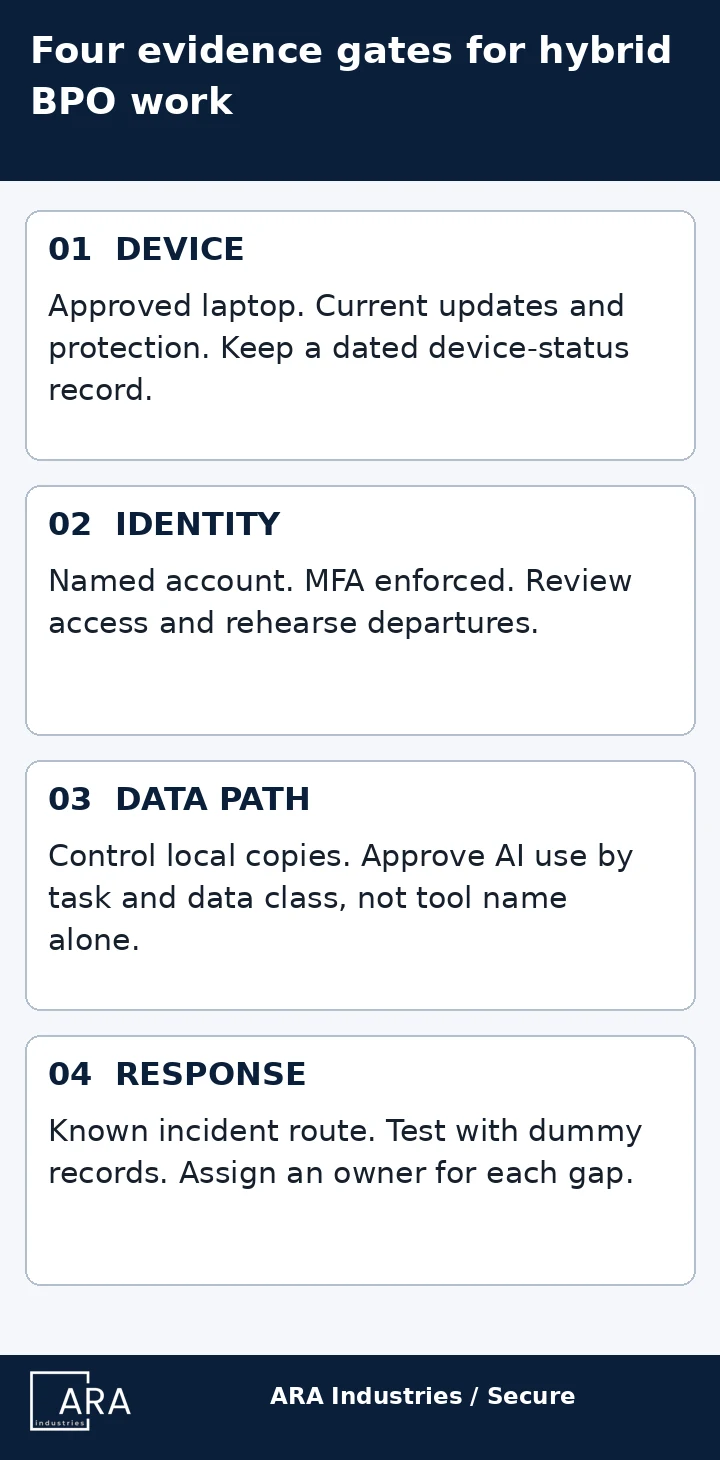
Original ARA Industries infographic. Text equivalent: Device → Identity → Data path → Response. Keep a dated record for each gate. Recommendations synthesized from sources 2, 3, 5 and 6; not a certification model.
What can your team check before the next shift?
Use this working sheet for one account. Mark verified, gap or not applicable with a reason; record an owner and date for every gap.
| Check | Evidence to collect | Suggested owner |
|---|---|---|
| Remote work is permitted for this workload | Approved account instructions and allowed locations | Operations |
| The actual laptop meets policy | Asset record and current device-status report | IT |
| Access is named and MFA-enforced | Role list and a dummy-record sign-in test | Identity administrator |
| Local copies follow the account rules | Demonstration of download, clipboard and printing controls | IT + Operations |
| AI use has a defined boundary | Approved use case, data class and provider review | DPO + account lead |
| Offboarding removes usable access | Test account disabled, sessions revoked and result recorded | IT + HR |
| Staff know how to report a mistake | Short rehearsal of the internal escalation route | Shift lead |
This is a recommended self-check, not a pass/fail security score. A “yes” without current evidence is a follow-up task. If a control is unavailable, restrict the workload or agree an alternative with the client before using real records.
What should you do next?
Start with the existing BPO Security Checklist, then use the evidence sheet above to turn the checklist into actions. Bring one account, one device and one access route to the review—not your entire estate at once.
If your team wants help prioritizing the gaps, talk to ARA Industries. Keep client records out of the initial inquiry; describe the workflow and the question you need answered.
General operational guidance, not legal advice or a PCI DSS assessment. Requirements depend on your processing, client contracts and applicable standards.
Which sources support this guide?
All links checked 8 November 2026 (PHT).
- IBPAP Knowledge Hub, hybrid-work FAQ; figures explicitly dated July 2023.
- NPC PHE Bulletin No. 12: Protecting Personal Data in a Work From Home Arrangement, 15 May 2020; updated 17 January 2022.
- Republic Act 10173, especially Sections 11, 14, 20 and 21; scope must be assessed for the actual processing.
- PCI SSC: Just Published, PCI DSS v4.0.1, 11 June 2024.
- PCI SSC: How PCI DSS Requirements Apply to WFH Environments, 25 June 2021; interpret alongside the current standard.
- NPC Advisory 2024-04, 19 December 2024, Sections 1–3.
Frequently asked questions
How can a Philippine BPO protect client data when staff work from home?
Use approved devices, named accounts with MFA, need-to-know access, controlled data handling and a tested incident route. Verify the account contract permits the workload and remote arrangement. These are recommendations, not a certification.
Does every BPO account need PCI DSS assessment?
No single answer fits every account. Determine whether the workflow handles payment-card data or can affect the cardholder data environment, then confirm scope and validation obligations with the client and the appropriate assessor.
Can agents use AI to summarize client conversations?
Only after the specific use case and data are approved and privacy, contractual and provider controls are reviewed. Approval for public text does not automatically cover identifiable client transcripts.
Where should a BPO team start its security review?
Use the ARA Industries BPO Security Checklist at /resources/checklist-bpo, then collect evidence for one account, one approved device and its actual access route.