
What “Scoping a Web or App Build” Should Look Like for a Busy PH Owner
Most Philippine owners do not fail a web project because they “lack vision.” They fail it in the quiet middle: unclear scope, plugin debt nobody owns, hosting logins on a freelancer’s personal email, and a handoff that never defined who updates content after launch. Busy owners buy a site the way they buy a vehicle — they want it to run — then discover six months later that nobody knows where the keys are.
This Insights piece is an authority how-we-work note from ARA Industries: what scoping a web or app build should look like when you are time-poor, PH-market practical, and allergic to vague proposals. Soft next step only — book a call to discuss requirements. No package theater.
What should scoping a web or app build cover?
Good scoping answers seven things: the primary job of the site for the next 12 months, who uses and operates it, what success looks like, which systems it must integrate with, what content exists, where it is hosted and who holds the keys, and what is explicitly out of scope for phase one. Colours and mockups come later. Book a call to scope yours.
Why scoping matters more than the mockup
A mockup shows how pages might look. Scoping decides whether the thing you buy can sell, take payment, complete a transaction, and support after-sales without collapsing under updates and handoffs.
That language is not marketing fluff. In January 2026, DICT and DTI coordination covered by the Philippine Information Agency discussed proposed baseline criteria for a “digital MSME,” including the ability to sell products online, accept digital payments, process electronic transactions, and implement after-sales policies. Whether or not your firm uses that label, those four capabilities are a useful owner checklist when you brief a build: Are we building a brochure, or an owned channel that can actually transact and follow up?
The scoping conversation in seven questions
Bring imperfect answers. Good scoping turns rough notes into a clear boundary. These are the practical questions a busy PH owner should expect — and ask back.
1. What is the primary job of this site or app in the next 12 months?
Brochure and credibility? Lead capture? Appointments? E-commerce? Client portal? Internal ops tool with a thin web front end? Pick one primary job. Secondary wishes go on a later phase list. Owners who want “everything” in phase one usually get nothing durable.
2. Who are the users — and who will operate it after launch?
Customers, patients, students, partners, staff? Who publishes content? Who answers form leads? Who renews hosting and domain? If “the freelancer” is the only answer, that is a risk item, not a staffing plan.
3. What must be true for you to call the launch successful?
Examples: “We can take GCash / card payments without manual chat,” “Clients can book without calling the front desk,” “Staff can update the menu / fees without opening a ticket.” Success criteria beat adjective-heavy briefs (“modern,” “premium,” “world-class”).
4. What systems must it talk to?
Email, CRM, payment gateway, accounting, scheduling, inventory, SMS? List must-integrate now vs nice later. Every integration is a scope line — and a failure mode if left implied.
5. What content and data do you already have — and what is missing?
Brand assets, product catalog, fee schedules, legal pages, privacy notice, after-sales policy. Digital MSME-style after-sales language (returns, support path, contact SLAs) should not be invented on launch week.
6. Where will it live, and who holds the keys?
Domain registrar, DNS, hosting panel, staging, production, analytics, payment merchant account. Prefer company-owned emails and documented handoff. Personal Gmail as the only DNS owner is a common PH pitfall.
7. What is explicitly out of scope for this phase?
SEO campaigns, paid ads management, social posting retainers, and ongoing content production are different services. A clean build scope says what the first release includes — and what it does not — so nobody is surprised at invoice time.
Common PH pitfalls (general patterns, not client case studies)
These show up often enough that good scoping names them early:
- Plugin debt: Too many plugins installed “just in case,” never updated, conflicting with each other. Prefer a short, justified plugin list with an update owner.
- Hosting and DNS fog: Site “somewhere,” SSL half-configured, DNS on a personal account, staging that shares production credentials.
- Handoff without acceptance: Launch day with no written acceptance checklist — content ownership, admin users, backup schedule, who to call when the form breaks.
- Brochure that pretends to transact: Product pages without payment, cart, or after-sales path — then surprise when buyers still negotiate everything in Messenger.
- Access sprawl: Former freelancers still admin; shared passwords in a chat thread; no MFA on the hosting panel. A quick cyber health check catches most of these.
- Scope creep by chat: “Small tweaks” that become a second product without a change note.
None of these require naming a client. They are industry patterns. Scoping is how you refuse them politely before money moves.
A simple how-we-work boundary
A healthy ARA Industries-style path looks like this:
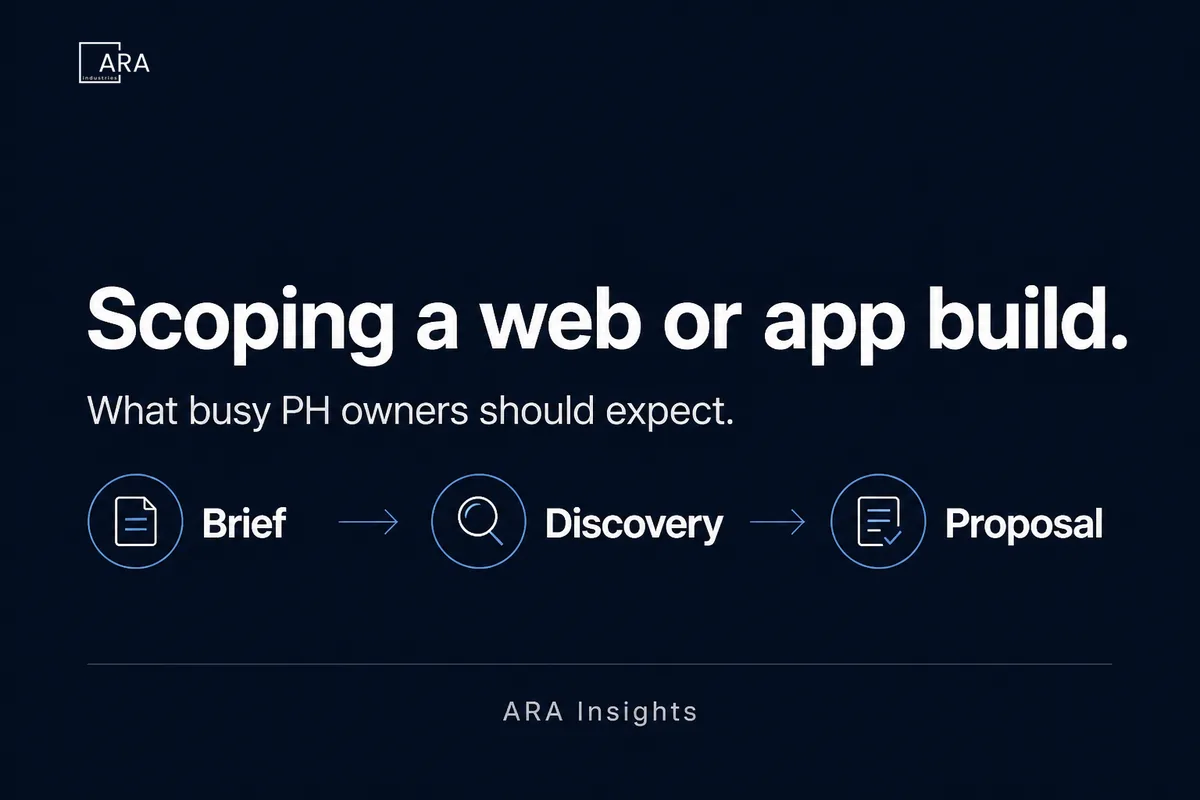
- Brief — you send goals, users, must-haves, and constraints (even bullet notes).
- Discovery / scoping call — we clarify primary job, integrations, content readiness, hosting ownership, and out-of-scope items.
- Proposal boundary — written scope for phase one; later phases listed separately.
- Build with staging — you see work before production.
- Acceptance and handoff — access, documentation, who operates what next.
That is not bureaucracy. It is how busy owners protect their time and avoid buying a site they cannot run.