Assess: see every device, account and gap
A fixed-scope cyber health check maps your endpoints, Microsoft 365 or Google Workspace settings, MFA coverage, backups and everything that faces the internet.
You getWritten findings and a ranked roadmap
Every business is a network of people, devices, apps and data. Most of it grew one tool at a time, and attackers look for the gaps in between. ARA Industries connects the dots, then secures them.
Laptops, phones, cloud apps, email, websites and shared drives were each added when they were needed. Nobody sees the whole picture, so nobody can defend it. Attackers do not need to break in through the front door; they probe the gaps between systems.
See what is hitting local organisations on our public Philippine Cyber Incident Map.
Five steps, one team. Each step produces something you can read, approve and own.
A fixed-scope cyber health check maps your endpoints, Microsoft 365 or Google Workspace settings, MFA coverage, backups and everything that faces the internet.
You getWritten findings and a ranked roadmap
We design how identity, devices, apps and data should connect, with Data Privacy Act (RA 10173) controls built in. Licences come only where they close a gap we found.
You getSolution design, budget and phased plan
Web apps, mobile apps, AI assistants and workflow automation, built on major cloud platforms and Microsoft 365, with access control, logging and secure coding from the first commit.
You getWorking software your team can run
MFA everywhere, WithSecure Elements endpoint protection with EDR/XDR, exposure management, email security and restore-tested backups, rolled out and tuned locally.
You getProtected endpoints, identities and data
Co-managed support or 24/7 Managed Detection and Response on WithSecure Elements. Alerts are triaged, threats contained, and you get a monthly report in business language.
You getDetection, response and monthly reporting
Every device is protected and watched. Identities are verified. Data flows are mapped and backed up. AI assistants and automations move work between your systems, inside the same access controls, so speed never costs you security.
Six practices, one approach: understand the requirement, design the system, then build and run it securely.
Design the controls first, then buy the licences. Health check, roadmap and DPA-aligned controls.
Explore 02We watch the console so your team does not have to. Co-managed or 24/7 MDR on WithSecure Elements.
Explore 03AI assistants and tools on your own data, with security, privacy and cost controls built in.
Explore 04Map the process, then automate the repetitive parts with AI and the tools you already own.
Explore 05Scope, platform and cloud design for web apps and eCommerce that scale and stay secure.
Explore 06Plan the app, the API and the cloud behind it, with security and store release built in.
ExploreWithSecure Elements brings endpoint protection, EDR/XDR, exposure management and Co-Security services into one cloud console built for mid-sized organisations. As a registered WithSecure partner, ARA Industries licenses, deploys, tunes and supports it locally, and can add 24/7 Managed Detection and Response.
Builds and engagements ARA Industries has delivered, mainly web and digital platforms. More about us.





Findings and a ranked roadmap before any licence quote.
BudgetA first estimate for your team size and risk.
DesignSample designs by scenario, to start your own plan.
WatchSourced, status-labelled incidents affecting Philippine organisations.
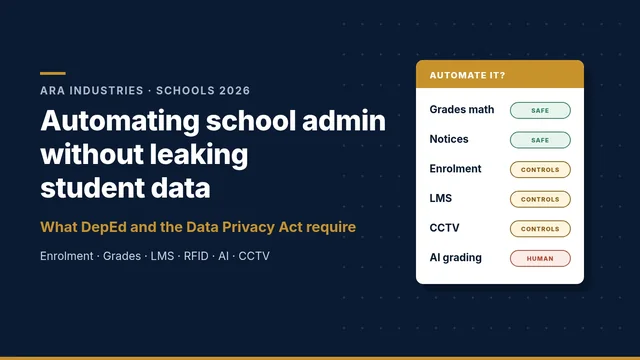
Grades and school records are sensitive data under the Data Privacy Act. Which enrolment, grading, LMS, RFID, payment, CCTV and AI workflows are safe…
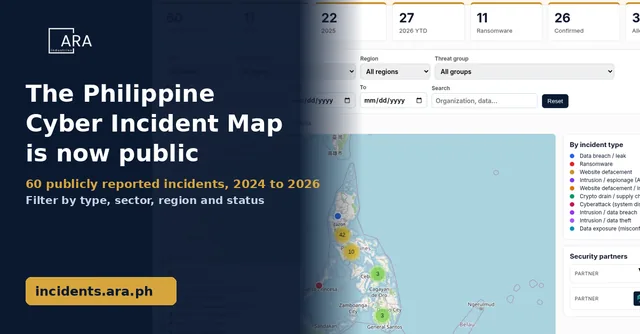
ARA Industries’ Philippine Cyber Incident Map is now public: 60 sourced, status-labelled incidents pinned to verified HQs.
The biggest crypto heists of 2025–2026 didn’t crack cold wallets. They fooled people. Here’s how, who’s behind them, the scams hitting Filipinos now,…
ARA Industries is a Philippine IT business solutions and cybersecurity company. We build web and mobile applications, AI and workflow automation, and cybersecurity solutions for Philippine businesses, and offer outsourced cybersecurity management with Managed Detection and Response on WithSecure Elements.
Yes. ARA Industries is a registered WithSecure partner and WithSecure is our preferred partner for endpoint protection, EDR/XDR, exposure management and MDR. We license, deploy and support WithSecure Elements locally.
In five steps: assess, design, build, secure and monitor. We start with a fixed-scope assessment such as a cyber health check, design the solution and roadmap, build or deploy it, secure it with the right controls, and then monitor and improve it, either co-managed or with 24/7 MDR.
Philippine businesses and multi-country teams, typically 20 to 500 people, that need senior IT and security expertise without a full in-house team. Our delivered work so far is mainly web and digital platforms; see Selected work on our About page. Schools planning a security or data-privacy upgrade can also book a consultation.
Book a Usap Tayo call or request a fixed-scope cyber health check. You receive written findings and a ranked roadmap before any licence quote.
We reply within one business day with a practical next step.
Prefer a call? Book a 30-minute Usap Tayo session.
Cookies on ara.ph
We use strictly necessary storage to run this site. With your permission we also use Google Analytics to see which pages help visitors, and Google Ads measurement to see which ads work. Nothing optional runs until you choose. Privacy policy and cookie list.